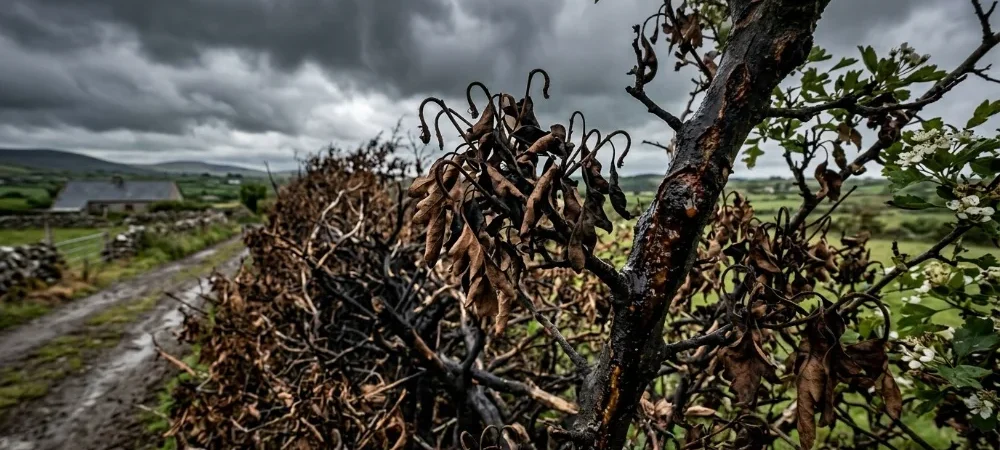
A quiet danger is spreading through the Irish countryside. It does not announce itself with noise or fanfare. It shows up as withered leaves, oozing cankers, and dying branches. The disease is called Fireblight, and the Hedge Laying Association of Ireland, now known as Hedgerows Ireland, has made it a central focus of its work . This bacterial infection poses a catastrophic risk to hawthorn, the very backbone of Ireland’s hedgerow network. The Association has raised serious concerns that the disease is being introduced through imported saplings, often used to meet planting demands under schemes like ACRES. There is no cure for Fireblight. Once a plant is infected, it must be destroyed. The organisation is calling for urgent government action to halt its spread and protect the living fabric of the Irish landscape .
What is Fireblight?
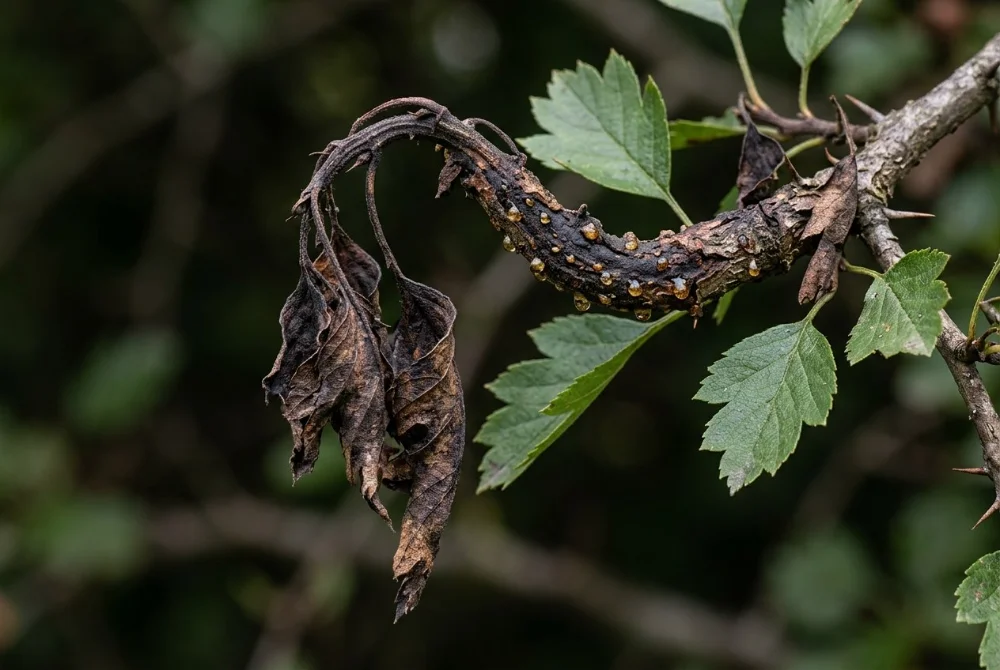
Fireblight is a bacterial disease caused by the organism Erwinia amylovora . It is one of the most destructive diseases affecting members of the Rosaceae family, which includes apples, pears, rowan, cotoneaster, and crucially, hawthorn . The disease gets its name from the characteristic appearance of infected plants. They look as though they have been scorched by fire. Young shoots and leaves wither and turn brown or black, curling into a shape that is sometimes called “shepherd’s crook” . Cankers form on branches and trunks, oozing a sticky, light brown liquid that contains millions of bacteria. This ooze is how the disease spreads. Insects, rain, wind, and even pruning tools can carry it from an infected plant to a healthy one .
The disease is not new to Ireland. It was first recorded here in 1986 on a cotoneaster plant in Dublin . Since then, outbreaks have occurred sporadically across the country. The Department of Agriculture, Food and the Marine confirmed 17 outbreaks across 11 counties in 2023 alone . Northern Ireland has had the disease for many years, and it is now considered widespread there . The problem is that Fireblight is perfectly suited to Ireland’s mild, damp climate. The bacteria thrive in the kind of weather that is common here, making the country particularly vulnerable to a major outbreak .
A Threat to Hawthorn
The most serious concern is the threat to hawthorn. Hawthorn is the most common species in Irish hedgerows. In some regions, it makes up as much as 85% to 88% of the hedgerow . These hedgerows are not just a pretty feature of the countryside. They are a vital habitat for wildlife. They are corridors for birds, insects, and small mammals. They are a source of food and shelter. They are also a cultural treasure, marking the boundaries of fields and townlands for centuries.
The consequences of a Fireblight outbreak among hawthorn hedgerows would be devastating. Once a hawthorn is infected, it cannot be saved. The only way to stop the disease from spreading is to destroy the infected plant, along with any other susceptible plants in the immediate area . This is not a theoretical risk. The disease previously caused the removal of more than 800 kilometres of hedgerows in Germany . In Ireland, the loss of hawthorn hedgerows on that scale would be catastrophic for biodiversity. It would also be a severe blow to the cultural identity of the Irish landscape.
The Importation Problem
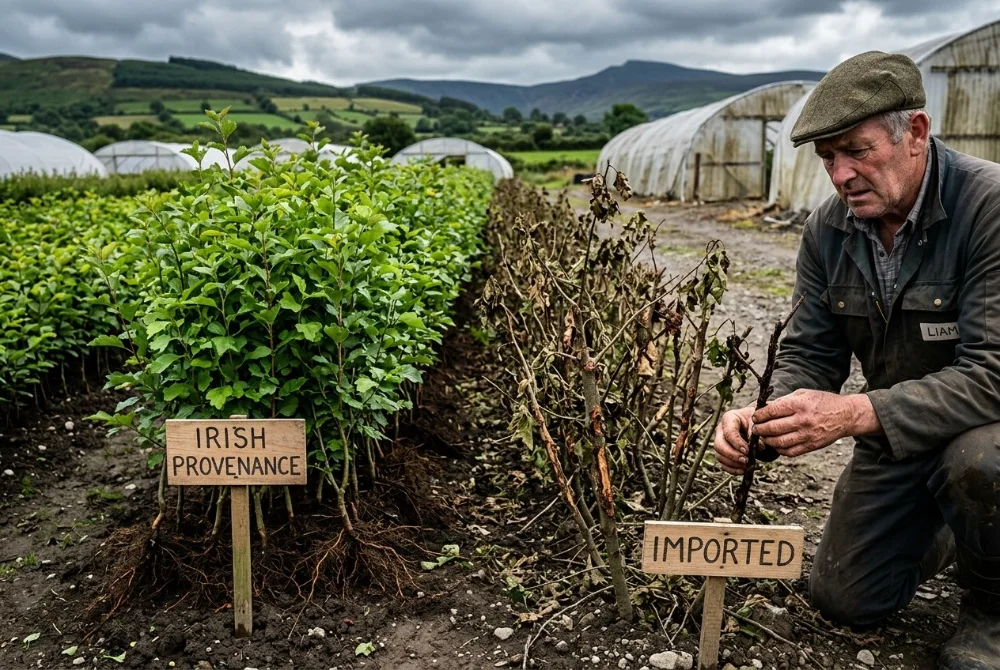
How is Fireblight spreading? The primary source is infected plant material imported from other countries . The Republic of Ireland had, until recently, a Protected Zone status for Fireblight. This meant that imports of host plants were restricted to areas known to be free of the disease . However, in May 2026, Ireland’s Protected Zone status was formally removed . This change was based on the findings of the Department’s plant health surveillance programme, which showed that the disease was already too widespread to meet the EU’s requirements for Protected Zone status .
The relaxation of import rules has caused alarm. Environmental organisations, including Hedgerows Ireland, have pointed out that the demand for hawthorn saplings has surged under the ACRES scheme. Farmers are being encouraged to plant new hedgerows, which is a positive development for the environment. However, the demand for Irish-grown, Irish-provenance saplings cannot always be met. This has created an incentive to import plants from abroad, where the risk of Fireblight is much higher . In 2023, Ireland imported over one million whitethorn (hawthorn) plants . Each of those plants could be carrying a disease that could destroy the very hedgerows the scheme is trying to create.
Hedgerows Ireland Campaign
Hedgerows Ireland has been at the forefront of the fight against Fireblight. The organisation has launched a campaign to raise awareness of the threat and to push for government action . In 2024, Hedgerows Ireland collaborated with An Taisce, the Environmental Pillar, and other environmental groups to create an open letter to the Minister for Agriculture, Food and the Marine . The letter collected almost 1,500 signatures from members of the public and called for urgent action . The letter pointed out that Ireland is still dealing with the fallout from ash dieback, a disease that was most likely introduced through imported plants. The organisations warned that the same mistake must not be made with Fireblight .
The open letter made four specific requests :
- Reinstate the Irish Provenance/Irish Origin requirement for hawthorn in ACRES hedgerow planting and delay planting actions until the demand-supply gap can be filled.
- Suspend imports of hawthorn plants due to the potential risk of importing disease.
- Clarify how natural and cultural hedgerow heritage was assessed when deciding the Generic Contingency Plan’s alert status for Fireblight.
- Continue to promote funding for native tree nurseries to ensure a sustainable supply of Irish-grown saplings.
The organisation has also hosted webinars, produced social media content, and engaged with newspapers and radio stations to spread the word about Fireblight . Mark McDowell, the Public Relations Officer for Hedgerows Ireland, has spoken passionately about the issue. He describes the hawthorn as a tree that marks the passage of natural time in Ireland, from its spring blossoms to its autumn berries. To risk losing it through the unnecessary importation of infected plants is, in his words, “indefensible and inexcusable” .
What You Can Do
The threat from Fireblight is serious, but it is not hopeless. There are practical steps that farmers, gardeners, and anyone who cares about the Irish countryside can take to help prevent the spread of the disease.
1. Know the Signs: Familiarise yourself with the symptoms of Fireblight . Look out for wilting shoots and leaves that turn brown or black. Look for cankers on branches and trunks. Check for sticky, light brown ooze. These symptoms are most visible during the growing season.
2. Report Suspected Cases: If you think you have found Fireblight, do not try to treat it yourself. Report it to the Department of Agriculture, Food and the Marine. You can do this by emailing plantandpests@agriculture.gov.ie . Early reporting is crucial for containing an outbreak before it can spread.
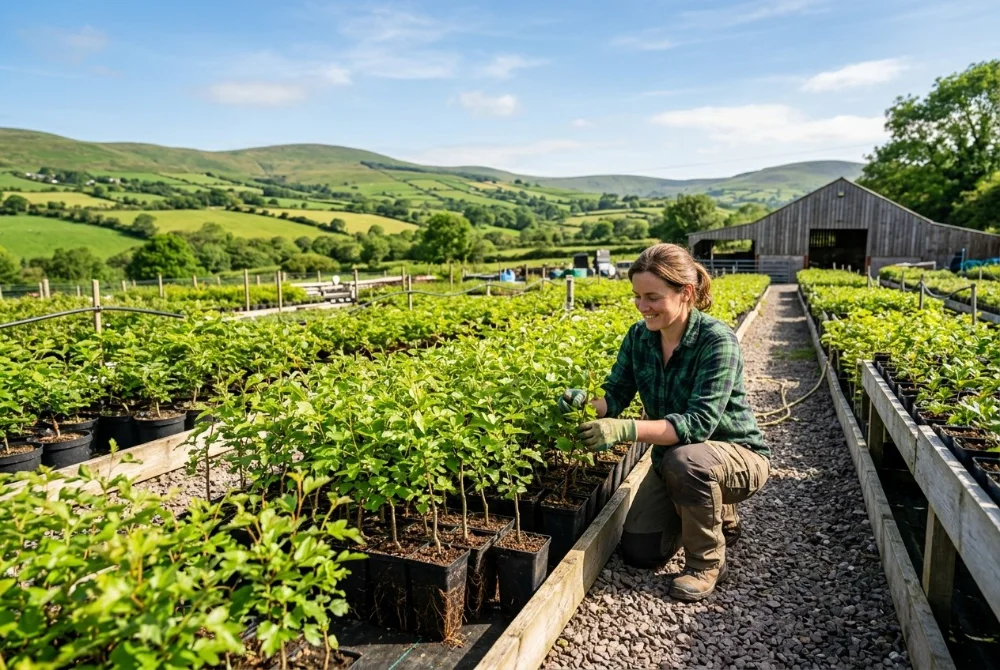
3. Buy Irish Provenance: When you are planting a new hedge or replacing trees, make sure you buy plants that are of Irish origin and provenance . This is one of the most effective ways to prevent the introduction of new plant diseases. Ask your supplier for proof that the plants were grown in Ireland from Irish seed. Support local nurseries that produce native trees. There is a list of potential suppliers on the Hedgerows Ireland website .
4. Disinfect Tools: Fireblight can be spread on pruning tools and machinery. Clean your tools regularly, especially if you have been working on diseased plants . A simple solution of household bleach and water is effective for killing the bacteria.
5. Support the Campaign: Support the work of Hedgerows Ireland. The organisation is a small, not-for-profit group that relies on the support of its members and the public . You can follow them on social media, share their posts, and get involved in their events. By spreading awareness, you are helping to build the public pressure needed to persuade the government to act.
A Future for Hawthorn
The loss of Ireland’s Protected Zone status is a setback, but it is not the end of the story. Hedgerows Ireland has made it clear that the organisation will continue to advocate for the protection of Ireland’s hedgerows . The focus is shifting from preventing the disease from arriving to managing its impact and preventing further spread. This means stricter controls on imports, better surveillance, and a major push for Irish-grown plants.
The health of Ireland’s hedgerows is not just a matter for farmers or for environmental groups. It is a matter for everyone who values the Irish countryside. The hedgerows are a living link to the past. They are a home for wildlife. They are a part of what makes Ireland special. Protecting them from Fireblight is a shared responsibility. By learning about the disease, reporting suspected cases, and choosing Irish-grown plants, everyone can play a part in preserving this precious heritage for future generations.
The hedgerow hawthorn, with its white blossoms and bright red haws, is woven into the fabric of Irish life. It belongs here. It is a native tree that has shaped the landscape for centuries. The thought of losing it to a disease that could have been prevented is a painful one. The work of Hedgerows Ireland is a reminder that it does not have to be that way. With vigilance, with action, and with a determination to protect what we have, the hawthorn can continue to mark the seasons in the Irish countryside for a long time to come.