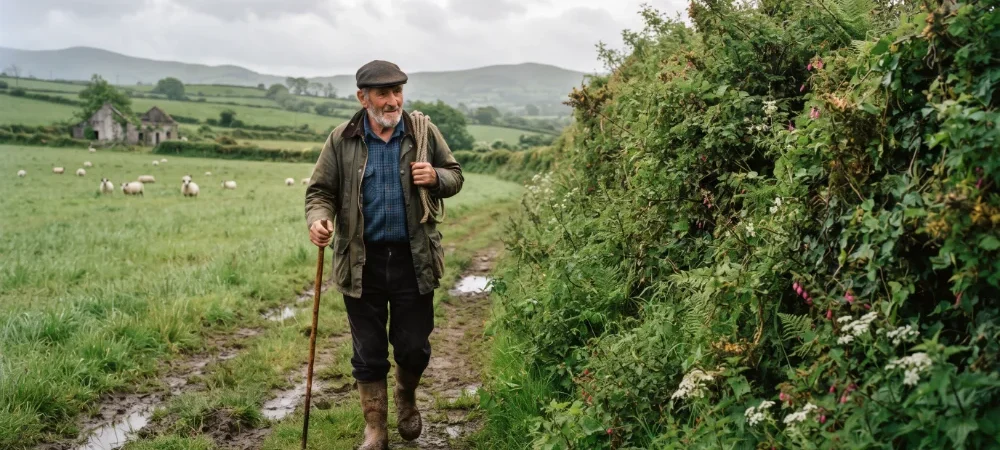
For Irish farmers, the hedgerow is not merely a boundary marker or a shelter for livestock. It is a financial asset, an ecological corridor, and increasingly, a source of direct income through the Agri-Climate Rural Environment Scheme (ACRES). Since its launch, ACRES has become the flagship environmental scheme for Irish agriculture, with a budget of €1.5 billion under Ireland’s CAP Strategic Plan . For those who manage hedgerows, the scheme offers concrete payments for planting, coppicing, and laying—activities that align traditional farming practices with modern biodiversity goals.
This guide sets out the payment rates, the specific requirements for each hedgerow action, and the practical steps farmers need to take to claim and retain these payments.
What Is ACRES and Why Does It Matter for Hedgerows?
ACRES is the Irish government’s primary agri-environmental scheme, designed to reward farmers for undertaking actions that benefit climate, biodiversity, and water quality. It operates under Pillar 2 of the Common Agricultural Policy and is co-funded by the National Exchequer and the European Agricultural Fund for Rural Development .
For hedgerow management, ACRES provides a direct financial incentive to do what many farmers have done for generations—but with a formal structure and guaranteed payment. The scheme recognises that hedgerows are the dominant habitat on most Irish farms, and that their quality varies significantly. As the scheme documentation notes, “good quality hedgerows provide multiple benefits, including crop protection, shelter and shade for livestock, improved biosecurity, water quality protection, carbon sequestration, pollen and nectar for bees and other pollinators, nesting, chick rearing and feeding resources for birds, and important foraging habitat for mammals” .
The hedgerow actions available under ACRES fall into two broad categories: General Actions (available to all participants) and Non-Productive Investments (NPIs) (targeted at specific environmental priorities). The payment rates and requirements differ between the two.
Planting a New Hedgerow: Payment Rates and Requirements
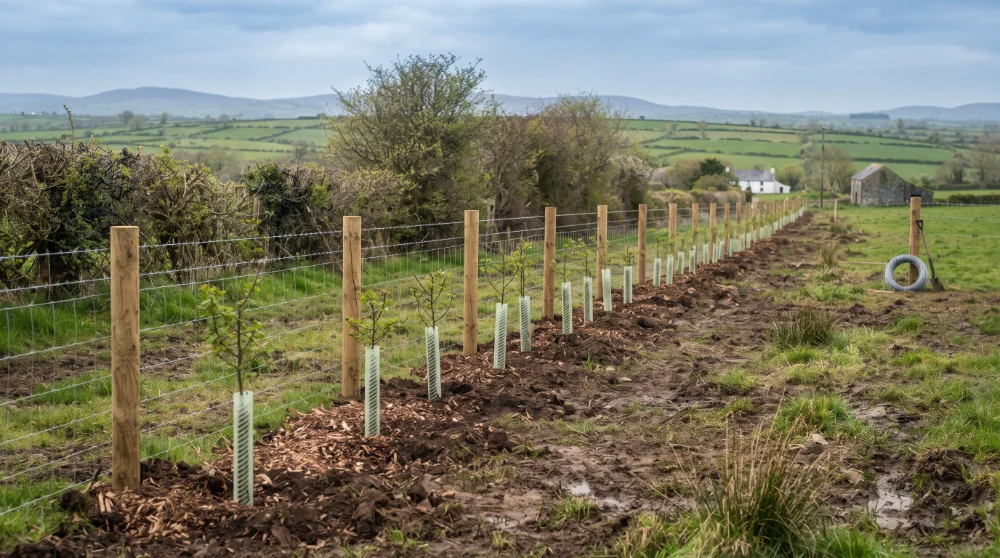
Planting a new hedgerow is one of the most accessible actions under ACRES. Under the General Actions, the payment rate is €5.29 per metre per year . For NPIs, the rate is higher at €23.10 per metre .
The maximum length payable for planting a new hedgerow under the General Actions is 750 metres . This is a significant increase from the limits on some other hedgerow actions, reflecting the importance the scheme places on establishing new habitat.
For practical guidance on establishing and managing hedges on the farm, you can watch this video:
The Planting Specification
The success of a new hedgerow depends on correct planting technique. The ACRES specification is precise, and failure to comply can result in penalties or payment clawback.
Plant density. A minimum of five plants per metre must be planted. This is a non-negotiable requirement. As Teagasc advisor Austin Callaghan explains, “if you have 100 metres of hedgerow to plant you must plant a minimum of 500 plants. The 500 plants cannot be in 110 metres, as in this situation there are not 5 plants per metre and the hedgerow isn’t planted as specified. This can result in a penalty” .
Species selection. Whitethorn (hawthorn) is the traditional choice and remains the dominant species. A significant amendment to the scheme has removed the Irish provenance requirement for whitethorn, meaning imported plants are now permitted for this species alone . However, all other species planted must be of Irish provenance (grown from Irish seed). It is recommended to plant a mix of species to enhance biodiversity—Guelder Rose, Holly, and Hazel are suggested options .
Plant passports. All hedgerow plants must have a plant passport. This document must be kept on file, as it will be required if the farm is inspected over the following three to four years .
Planting technique. Plants should be set in a double staggered row, with the soil prepared to a width of approximately 1.5 metres to reduce competition from grasses . The young plants should be pruned after planting, cut at an angle approximately 3 to 5 centimetres above ground level. This encourages multiple growing tips and results in a denser, more stockproof hedge .
Tree retention. Every 50 metres, a tree should be allowed to grow up within the hedge line. This provides structural diversity and long-term habitat value .
Protection and Maintenance
Newly planted hedgerows must be protected from livestock. A suitable fence should be erected at least 1.5 metres from the plants, and tree guards should be used where deer or hares are present . Competing vegetation must be controlled for the first few years, but strimmers should be used with great care as they can easily damage young plants .
Failed plants must be replaced in the following planting season. This is a requirement of the scheme, not merely good practice .
Coppicing and Laying: Payments for Existing Hedges
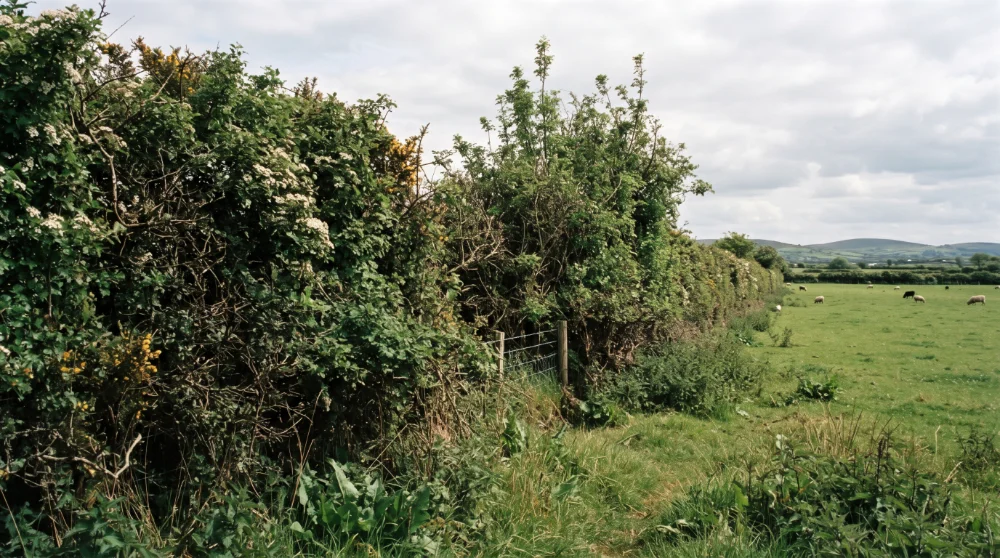
For farmers with existing hedgerows that have become gappy, top-heavy, or no longer stockproof, ACRES offers payments for rejuvenation through coppicing or laying.
Coppicing
Coppicing involves cutting the hedge stems close to the ground (approximately 15 centimetres above soil level) to encourage new growth from the base . Under the General Actions, the payment rate for coppicing is €2.87 per metre per year, paid for five years . The minimum length is 10 metres, and the maximum is 400 metres .
Hedge Laying
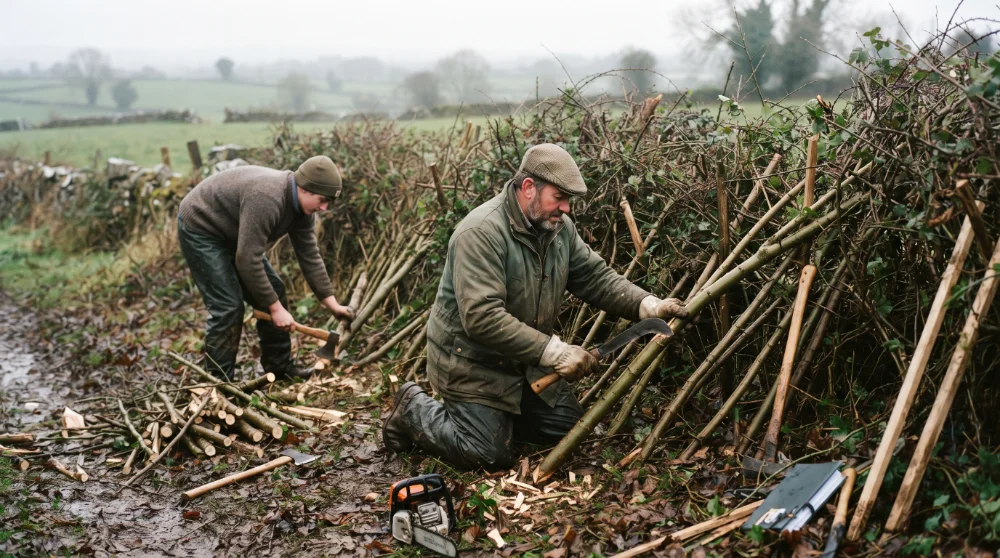
Hedge laying is the traditional craft of partially cutting the stems and laying them at an angle to create a living, stockproof barrier. Under ACRES, the payment rate for laying is €5.47 per metre per year, also paid for five years . The maximum length is 400 metres .
Both coppicing and laying must be carried out between September and February to avoid disturbing nesting birds . This aligns with the legal restrictions on hedge cutting discussed in our previous guide.
The NPI Option: Higher Payments for Targeted Work
The Non-Productive Investment (NPI) stream of ACRES offers higher payment rates for hedgerow work that targets specific environmental priorities. For planting new hedges, the NPI rate is €23.10 per metre . For hedgerow rejuvenation (which encompasses both coppicing and laying as part of a broader habitat improvement measure), the rate can be up to €18.88 per metre .
The NPI actions are more prescriptive. For example, the NPI Planting New Hedges specification recommends a mix of at least three species, with no single species making up more than 85% of the total. It also provides detailed guidance on site selection, advising against planting in areas where breeding waders, geese, or swans are objectives, and on peatlands or exposed coastal sites .
The Hedgerow Requirement: A Critical Condition

One of the most important conditions of ACRES participation is the hedgerow requirement that applies to all area-based actions. This is not a payment action in itself, but a condition that must be met on any parcel where an ACRES area-based action is undertaken.
The rule is straightforward but strictly enforced: if existing hedges are greater than 1.8 metres in height, cutting or trimming is permitted once they are not cut below 1.8 metres from ground level. If existing hedges are less than 1.8 metres, they must not be cut or trimmed .
There are limited exceptions: roadside hedgerows, hedgerows on external farm boundaries, newly established hedgerows (less than 10 years old), hedgerows that were recently coppiced or laid, and hedgerows in Breeding Wader hotspot areas .
The purpose of this rule is to ensure that hedgerows retain their structural value for wildlife. A hedge cut to 1.5 metres provides far less shelter and nesting opportunity than one allowed to grow to 2.5 metres. The scheme documentation advises that where cutting is undertaken, it should not be done on all hedges on the farm in the same year, and that an “A” shape cut—allowing the base and sides to receive more light—is preferable to a flat top .
Practical Steps for Farmers
For farmers considering or already participating in ACRES, the following steps will help ensure compliance and successful payment.
Review your ACRES plan. The plan sets out the specific actions selected and the associated payment rates. Ensure you understand what is required for each hedgerow action.
Check plant passports. For any new planting, confirm that the plants are from a registered professional operator and that the passports are on file.
Plan the timing. Planting should be completed by the deadline specified for your tranche. Coppicing and laying must be done between September and February. Cutting of existing hedgerows (where permitted) should also be scheduled for the open season.
Document everything. Keep photographs of completed work, receipts for plants and materials, and records of any inspections. The scheme is subject to inspection, and documentation is the farmer’s best defence.
Consider the NPI option. If your farm has specific environmental priorities—such as water quality or habitat connectivity—the NPI stream may offer higher payments for hedgerow work that addresses these objectives.
Conclusion
ACRES represents a significant opportunity for Irish farmers to receive direct payment for hedgerow management. The rates—€5.29 per metre for new planting, €2.87 for coppicing, €5.47 for laying under the General Actions, with higher rates available through NPIs—provide a financial return that complements the long-term agronomic and ecological benefits of a well-managed hedgerow.
The scheme is not without complexity. The planting specification is detailed, the hedgerow requirement is strictly enforced, and the documentation requirements are real. But for those who take the time to understand the rules, ACRES offers a practical route to improving the farm’s natural capital while receiving a guaranteed income for the work.