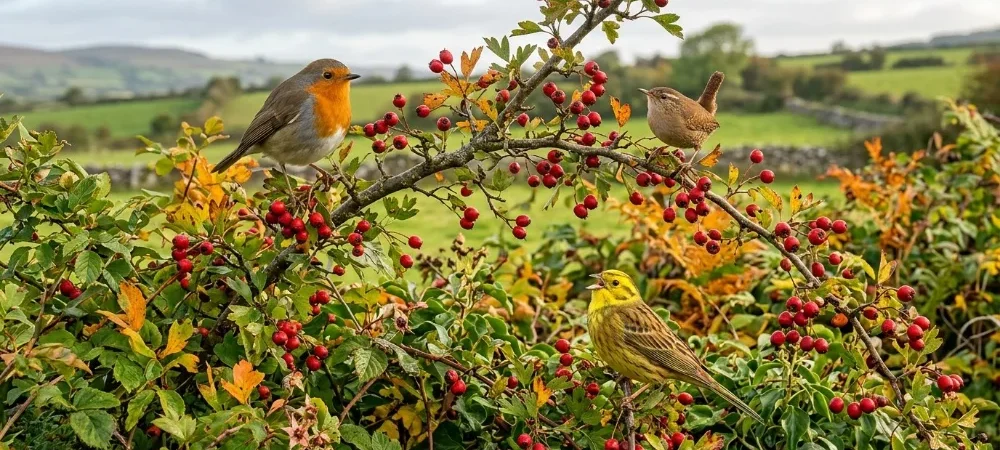
Creating a Sanctuary for Wildlife
The Hedge Laying Association of Ireland has long understood that a healthy hedgerow is far more than just a line of bushes dividing fields. It is a living structure, a haven for wildlife, and a thread that weaves the Irish countryside together. The Association has consistently drawn attention to the critical role that well-managed hedgerows play in supporting the country’s biodiversity, pointing to research that shows just how vital these boundaries are for birds, insects, and other creatures .
A Network of Life
Hedgerows are sometimes described as the green arteries of the landscape. They connect habitats that would otherwise be isolated, allowing birds, insects, and small mammals to move between woodlands, rivers, wetlands, and grasslands . This movement is not just a convenience. It is essential for finding food, seeking new territories, and maintaining genetic diversity. When hedgerows are lost or become gappy, the landscape becomes fragmented. Populations of some species can become isolated, which puts them at greater risk of local extinction. The Hedge Laying Association of Ireland has been involved in developing the Hedgerow Appraisal System, a tool designed to help assess the condition of these networks and ensure that they are managed in a way that preserves their value as wildlife corridors . This system provides a way to collect consistent data, helping to build a picture of the health of Ireland’s hedgerows and guiding future conservation efforts.
The numbers tell a compelling story. Of the 110 bird species regularly recorded in the Countryside Bird Survey, 55 of them use hedgerows. Of these, 35 species actually build their nests in them . These are not just casual visitors. They rely on hedgerows for shelter, for food, and for a safe place to raise their young. The dense branches of a well-maintained hedge offer protection from predators, while the insects that live in and around the hedge help to feed hungry chicks. Later in the year, the berries of hawthorn, blackthorn, holly, and bramble become a vital food source as insects become scarcer. The Hedge Laying Association of Ireland has worked alongside BirdWatch Ireland and other organisations to highlight this dependence and to advocate for management practices that put the needs of wildlife first .
A Home for Birds and Insects
The connection between hedgerows and birdlife is particularly strong. Birds like the robin, the wren, the blackbird, and the yellowhammer are familiar sights in the Irish countryside, and they all depend on hedgerows for nesting. But it is not just the common species that benefit. Some of Ireland’s most vulnerable birds also rely on these boundaries. The yellowhammer, which is a red-listed species of conservation concern, is one of them. The linnet and the greenfinch are amber-listed species that also depend on hedgerows for food and shelter . The Hedge Laying Association of Ireland has raised concerns that changes to the laws governing hedge cutting could put these birds at even greater risk .
The timing of hedge cutting is critical. Under the Wildlife Acts, it is an offence to cut, burn, or otherwise destroy vegetation, including hedges, between the 1st of March and the 31st of August . This closed period is designed to protect nesting birds and their young. Cutting during this time can destroy nests and eggs or cause adult birds to abandon their chicks. The Hedge Laying Association of Ireland has been a vocal opponent of any proposals that would weaken these protections, arguing that such changes would have a negative impact on biodiversity . Neil Foulkes, representing the Association, told an Oireachtas committee that any suggestion a hedge can be cut without impacting on wildlife is not credible. He stressed that it is simply a question of the degree and nature of the impact . The Association has also pointed out that hedgerows have no legal protection in their own right. They are only protected as nesting sites for birds, which is a significant gap in the law .
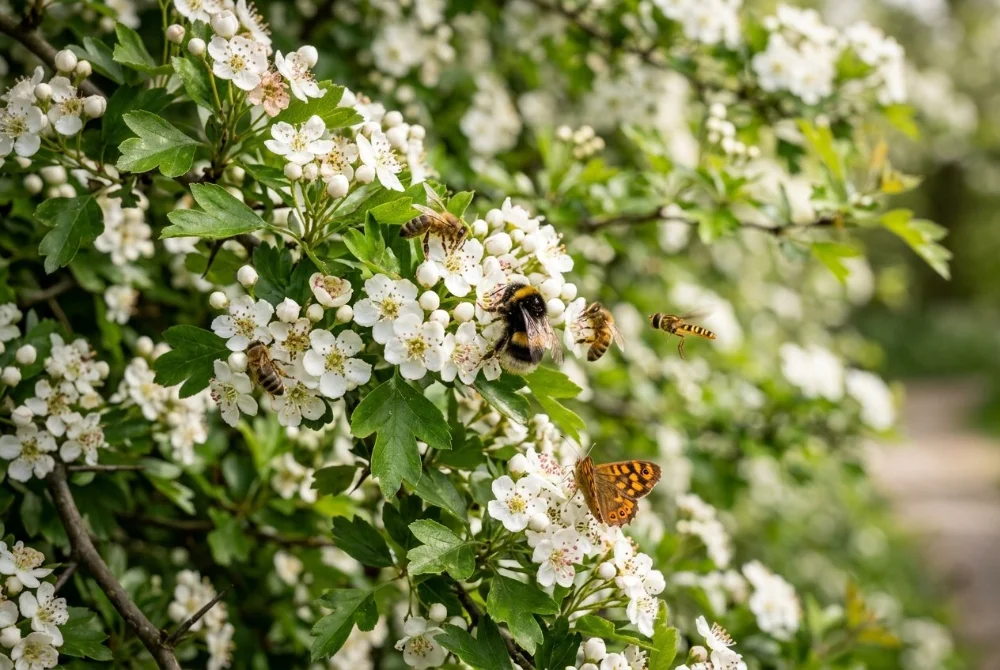
It is not just birds that find a home in hedgerows. The insect life is extraordinary. Even if much of it goes unnoticed, a good hedge is alive with activity . In the spring, hedgerow flowers provide some of the first nectar and pollen of the year for bees, butterflies, and hoverflies. Through the summer, thousands of insects live among the leaves and flowers, helping to pollinate crops and wild plants. The species composition of a hedge is important for insects. Hawthorn, which is found in 98% of Irish hedgerows, is of particularly high value. A single hawthorn hedge supports 62 species of larger Irish moths . Willow is even better, supporting an incredible 115 of the larger moth species. Birch supports 102, and oak supports 72 . These figures only count the larger moths; there are hundreds of smaller species that also depend on these plants. The Hedge Laying Association of Ireland encourages management practices that maintain this diversity, such as allowing some hedges to grow out and develop into treelines, which are especially good for butterflies and moths .
The Threat of Fireblight
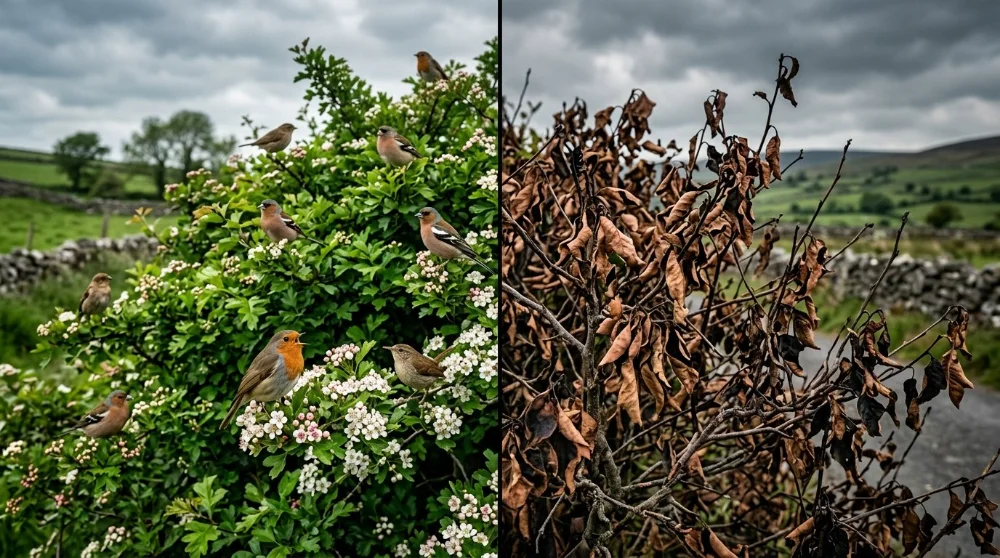
One of the most serious threats to Ireland’s hedgerows is the bacterial disease known as fireblight . This disease affects over 200 species of plants, including hawthorn, apple, pear, and mountain ash . Once a plant is infected, there is no cure. The disease can be spread by rain, by wind, and by insects, making it well-suited to Ireland’s damp climate. The Hedge Laying Association of Ireland has expressed serious concerns about the spread of this disease, which has been detected in 21 counties across Ireland in recent years .
The disease was historically confined to a few areas, but it is now spreading rapidly. There is a fear that it could be far more devastating than ash dieback, not least because it affects so many different species. The Association has highlighted the role that imported saplings may play in spreading the disease. The Department of Agriculture relaxed rules on the importation of whitethorn hedging to meet the demand created by agri-environmental schemes like ACRES. This move has been criticised by farmers and conservationists, who point out that it has brought an increased risk of introducing fireblight to the country . The Association has called for greater transparency and for a tightening of the rules to prevent further spread. As one farmer wrote in the Irish Farmers Journal, “Our fireblight status needs to be protected – where outbreaks are already identified, these need to be brought under control” .
A Shared Responsibility
The health of Ireland’s hedgerows is not just a matter for farmers or for conservation groups. It is a shared responsibility. The Hedge Laying Association of Ireland has worked to raise awareness among the public and to encourage landowners to adopt better management practices. This includes measures like leaving some hedges uncut each year, allowing them to flower and produce berries, and maintaining a grassy margin at the base . Cutting hedges on a rotation, rather than every year, encourages more flowers and fruit and creates a mix of hedge ages and structures across the landscape. The Association has also stressed the importance of retaining the occasional mature tree within a hedgerow and of avoiding cutting a hedge too low .
The effort is paying off. There is a growing recognition of the value of hedgerows and a renewed interest in the traditional skills needed to maintain them. The Hedge Laying Association of Ireland is at the centre of this revival, teaching new generations of hedge layers and advocating for the protection of these ancient boundaries. The work is urgent. With threats from disease, from development, and from mismanagement, Ireland’s hedgerows cannot be taken for granted. The Association’s message is clear: the health of the hedgerows is the health of the countryside itself. By learning about and applying the principles of good hedgerow management, everyone can play a part in creating sanctuaries for wildlife and preserving a vital part of Ireland’s natural and cultural heritage.