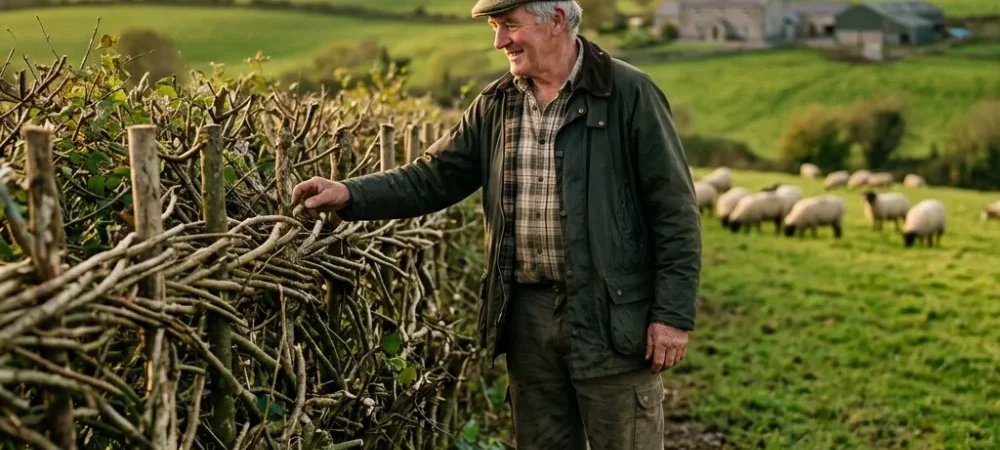
For many Irish farmers, the hedgerow is a familiar sight. It marks the boundary of the field, provides some shelter for livestock, and is often trimmed each year to keep it tidy. But the Hedge Laying Association of Ireland has long pointed out that these green boundaries represent something far more valuable. A well-managed hedgerow, especially one rejuvenated through traditional hedge laying, offers a range of practical and financial benefits that are often overlooked. Under schemes like ACRES, farmers can receive direct financial support for coppicing and laying hedges . Beyond this direct income, a thick, laid hedge provides shelter for livestock, reduces the need for fencing, and contributes to the long-term health of the farm. The Association actively works to inform the farming community about these advantages.
A Living Asset on the Farm
Hedgerows in Ireland are a remarkable resource. According to estimates, there are approximately 689,000 kilometres of hedgerows across the country . Many of these are in poor condition. Years of neglect or inappropriate mechanical trimming have left them gappy, weak at the base, and of limited value to either wildlife or the farm business. But a hedge that is properly managed is an asset that can serve the farm for generations.
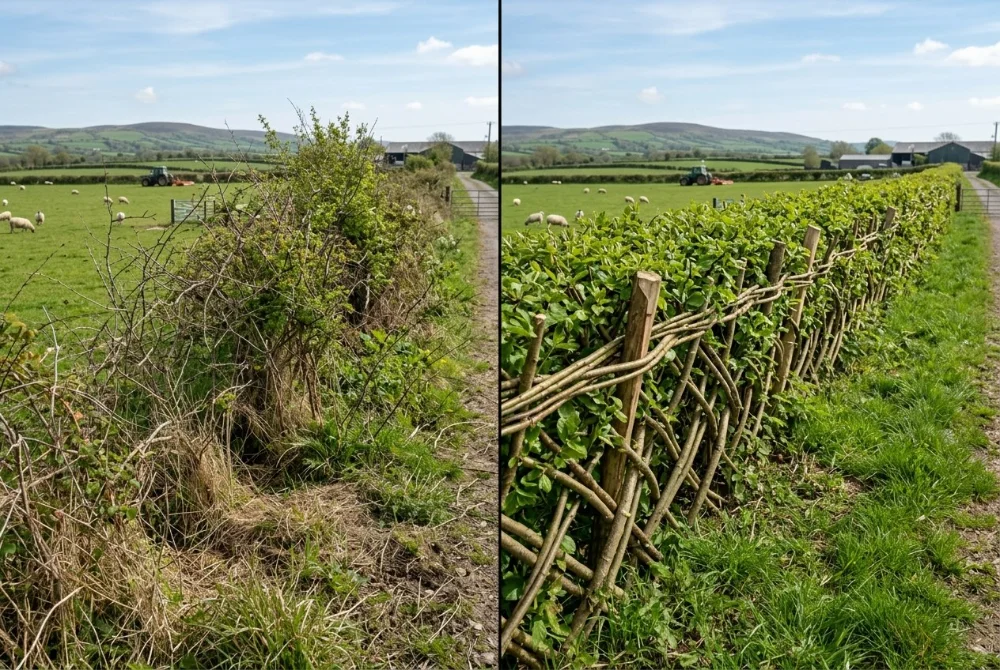
A laid hedge is a durable barrier. The technique of cutting stems partway through near ground level and bending them over creates a dense, woven structure that is stock-proof for up to thirty years or more . This is a significant advantage over wire fencing, which requires regular maintenance and replacement. The cost of wire, posts, and labour adds up quickly. For a farm with many boundaries, the savings from a well-maintained laid hedge can be substantial. Farmers who have invested in hedge laying often find that the work pays for itself over time through reduced fencing costs alone.
The durability of a laid hedge comes from the fact that the stems remain alive. New shoots grow from the cut base, thickening the hedge and creating a strong, living wall. This is far more resilient than a line of dead stakes and wire. The laid structure holds the cut stems in place, preventing them from being pushed open by livestock. It is a natural fence that grows stronger with time, provided it is managed properly. The Hedge Laying Association of Ireland has been at the forefront of teaching farmers how to achieve these results through its training courses and demonstrations .
Financial Support Through Agri-Environmental Schemes
The financial case for hedge laying has been strengthened considerably by agri-environmental schemes. Since the introduction of REPS, and later GLAS, farmers have been able to receive payments for managing hedgerows in ways that benefit wildlife and the environment . GLAS, which ran from 2015, provided payments for specific actions, including hedge laying . This helped to raise awareness and increase the demand for training courses .
The current scheme, ACRES, continues this support. The Agri-Climate Rural Environment Scheme is a €1.5 billion programme designed to support up to 50,000 farm families in Ireland . It includes payments for planting new hedgerows and for managing existing ones through traditional methods . The scheme is results-based in many areas, meaning payments are linked to the environmental quality of the habitat, encouraging farmers to manage their land with biodiversity in mind .
However, the transition from GLAS to ACRES has not been without its challenges. Some farmers have reported that the shift from an action-based scheme to a results-based one has led to a reduction in payments, particularly for those in ACRES Co-operation areas . There have also been complaints about administration costs and the complexity of the new scoring system . The Hedge Laying Association of Ireland has observed these concerns and continues to advise farmers on the best way to navigate the scheme and secure payments for hedgerow management actions. Despite the difficulties, the potential to receive direct income for hedge laying and other positive management practices remains a significant incentive for many farmers.
Shelter and Livestock Health
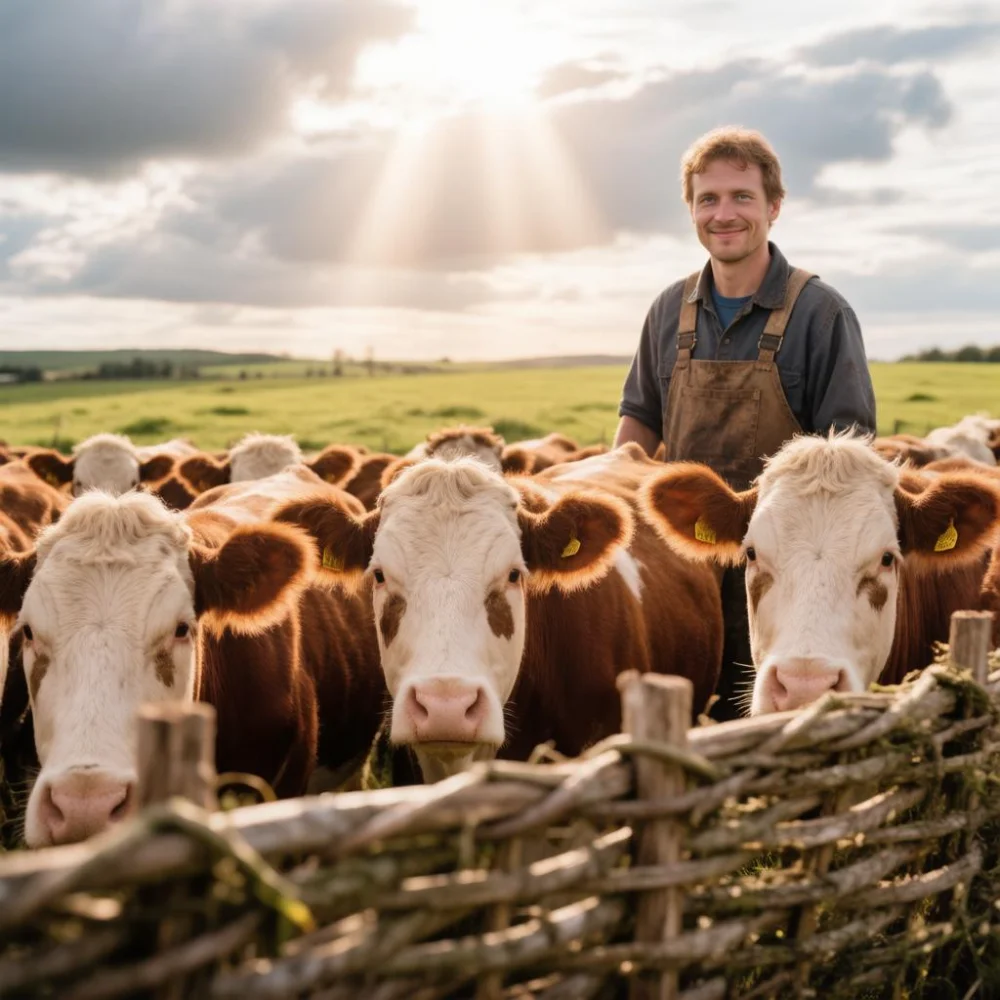
One of the most immediate and practical benefits of a well-managed hedgerow is the shelter it provides for livestock. A dense, thick hedge acts as a windbreak, reducing the exposure of animals to cold winds and driving rain. This is not just about comfort. For young lambs and calves, exposure to harsh weather can be fatal. For adult stock, stress from cold and wet conditions can reduce feed conversion efficiency and increase the risk of disease.
The shelter provided by a healthy hedgerow extends across the field. The lee side of a hedge can offer protection for a distance of up to thirty times the height of the hedge . This can improve pasture growth by reducing wind chill and evaporation, leading to better grass utilisation and a longer grazing season. The result is a healthier herd and a lower overall cost of production. A farm with good hedgerow shelter is a farm that is more resilient to the vagaries of the Irish climate.
The benefits extend to the soil as well. Hedgerows intercept runoff and prevent sediment loss to watercourses . The root systems help to stabilise banks and reduce soil erosion. This is particularly important on sloping land, where heavy rain can wash away precious topsoil. By keeping soil in place, hedgerows help to maintain the fertility of the field and prevent the pollution of nearby streams and rivers. The Hedge Laying Association of Ireland has long championed these benefits, arguing that healthy hedgerows are essential for both productive farming and a healthy environment.
Learning the Skills
For farmers who are interested in taking advantage of these benefits, the first step is often to learn the necessary skills. Hedge laying is a craft that requires knowledge and practice. The Hedge Laying Association of Ireland has been central to providing this training. The Association runs workshops and training courses across the country, teaching farmers and landowners the techniques of hedge laying . These courses are practical, hands-on events where participants learn how to assess a hedge, how to make the right cuts, and how to lay the stems effectively.
The interest in these courses has grown in recent years. As more farmers become aware of the value of healthy hedgerows and the availability of payments under ACRES, the demand for training has increased . The Association is also involved in the All-Ireland Hedge Laying Championships, an event that showcases the skills of the country’s best hedge layers and helps to promote the craft . The Association’s members, many of whom are farmers themselves, are committed to passing on their knowledge and ensuring that the tradition continues.
A Sustainable Investment
The economic case for hedge laying is clear. It is a practice that can generate direct income through agri-environmental schemes, reduce long-term costs by providing durable fencing, and improve livestock health and productivity through shelter. It is an investment in the farm that pays dividends over many years. The Hedge Laying Association of Ireland is the key source of information and training for farmers who want to make the most of their hedgerows. By learning the skills and adopting the right approach to management, farmers can turn their hedges from a simple boundary into a valuable and productive asset. The health of the hedgerows is the health of the farm.